
Let me be blunt:
Writing notes is one of the least effective ways to prepare for exams.
Not because notes are useless - but because they trick you into thinking you're learning when you're actually just... copying.
And yet, it's what most students spend the majority of their revision time doing.
Here's why that's a problem - and what actually works instead.
1. Notes Feel Productive - But They Don't Train Your Brain
Writing notes feels good.
It feels:
✔ Organised
✔ Calm
✔ Responsible
✔ Like "proper revision"
You finish a session with pages of beautifully colour-coded notes and think: "I've done so much today."
But here's the problem:
Feeling productive isn't the same as being productive.
When you copy information - whether from a textbook, a PowerPoint, or a video - your brain stays passive.
You're processing the words just enough to write them down. But you're not encoding them into long-term memory.
And exams don't reward recognition (seeing something and thinking "oh yeah, I remember that").
They reward recall - pulling information out of your brain when there's nothing to prompt you.
The Research:
A study by Karpicke and Roediger (2008) found that students who tested themselves on material remembered 50% more a week later than students who just studied and re-studied their notes.
Another study (Mueller & Oppenheimer, 2014) found that students who took notes by hand performed better on conceptual questions - but only if they then actively reviewed and tested themselves on those notes later.
Just writing notes and never using them? Almost no benefit.
2. Notes Don't Teach You How to Use Information
Here's something most students miss:
GCSEs are not memory tests.
They don't ask: "What do you know about photosynthesis?"
They ask: "Explain how the structure of a leaf is adapted for photosynthesis."
Or: "Evaluate the impact of climate change on photosynthesis rates."
See the difference?
You need to:
✔ Analyse
✔ Evaluate
✔ Apply knowledge to new contexts
✔ Justify your reasoning
✔ Structure arguments
✔ Link evidence to conclusions
Writing notes trains none of these skills.
You can have perfect notes and still score average marks - because knowing facts doesn't mean you can use them under exam conditions.
3. Notes Are Passive - Exams Are Active
Here's the real problem:
Most revision is passive. Exams are active.
Passive Revision:
Reading notes
Highlighting textbooks
Rewriting information
Watching videos
Copying diagrams
Your brain is receiving information, but it's not working for it.
Active Revision:
Answering exam questions from memory
Planning essay structures in 2 minutes
Writing timed paragraphs
Testing yourself with flashcards (and actually trying to recall before flipping)
Fixing mistakes immediately
Drilling answer templates
Your brain is struggling to retrieve, apply, and structure information.
And that struggle is what builds long-term memory.
The Research:
This is called the "generation effect" - when you actively generate an answer (even if you get it wrong), you remember it far better than if you just passively read it.
A meta-analysis by Dunlosky et al. (2013) ranked the most effective study techniques. Practice testing and distributed practice (spacing out your revision) were at the top.
Re-reading and highlighting? Rated as low utility - they don't work.
Only one type of revision raises your grade. And it's not the one that feels easiest.
4. Notes Steal Time From What Actually Works
Here's the hard truth:
Time spent writing notes is time NOT spent practising exam skills.
Ask yourself:
Would a Grade 9 student spend three hours rewriting their Biology notes?
No.
They'd spend that time:
✔ Answering past paper questions
✔ Analysing mark schemes to see what examiners want
✔ Building answer templates they can adapt to any question
✔ Identifying and fixing recurring mistakes
✔ Practising under timed conditions
✔ Testing themselves without looking at notes first
That's why they improve faster.
They're not revising the content. They're training performance.
So... Are Notes Actually Useful?
Yes - but only if you use them strategically.
Here's the rule:
👉 If making notes takes longer than 10 minutes, you're doing it wrong.
Notes should be:
Quick summaries (not full rewrites)
Memory triggers (keywords, diagrams, key quotes)
Reference material (something to check when you're stuck)
They should not be:
Your main revision method
Pages of copied information
Something you spend hours perfecting
A Better Way to Use Notes:
Instead of making notes for hours, try this:
Read a section (5 -10 minutes)
Close the book and write down everything you remember (5 minutes)
Check what you missed and add it in a different colour (2 minutes)
Test yourself again the next day without looking (5 minutes)
This forces active recall - which is what actually builds memory.
What You Should Be Doing Instead
If notes aren't the answer, what is?
Here's what the research (and my own experience tutoring) shows actually works:
1. Practice Exam Questions (The Most Important One)
This is non-negotiable.
If you're not doing real exam questions regularly, you're not preparing for exams. You're just learning content.
Start with:
One question at a time (don't wait until you've "finished revising" a topic)
Timed attempts (4 minutes for a 6-mark question, for example)
Immediate comparison to the mark scheme (don't just check if you're right - check how to write the perfect answer)
Once you start working through past papers, you'll quickly notice that exam questions follow patterns - they repeat more than you'd think.
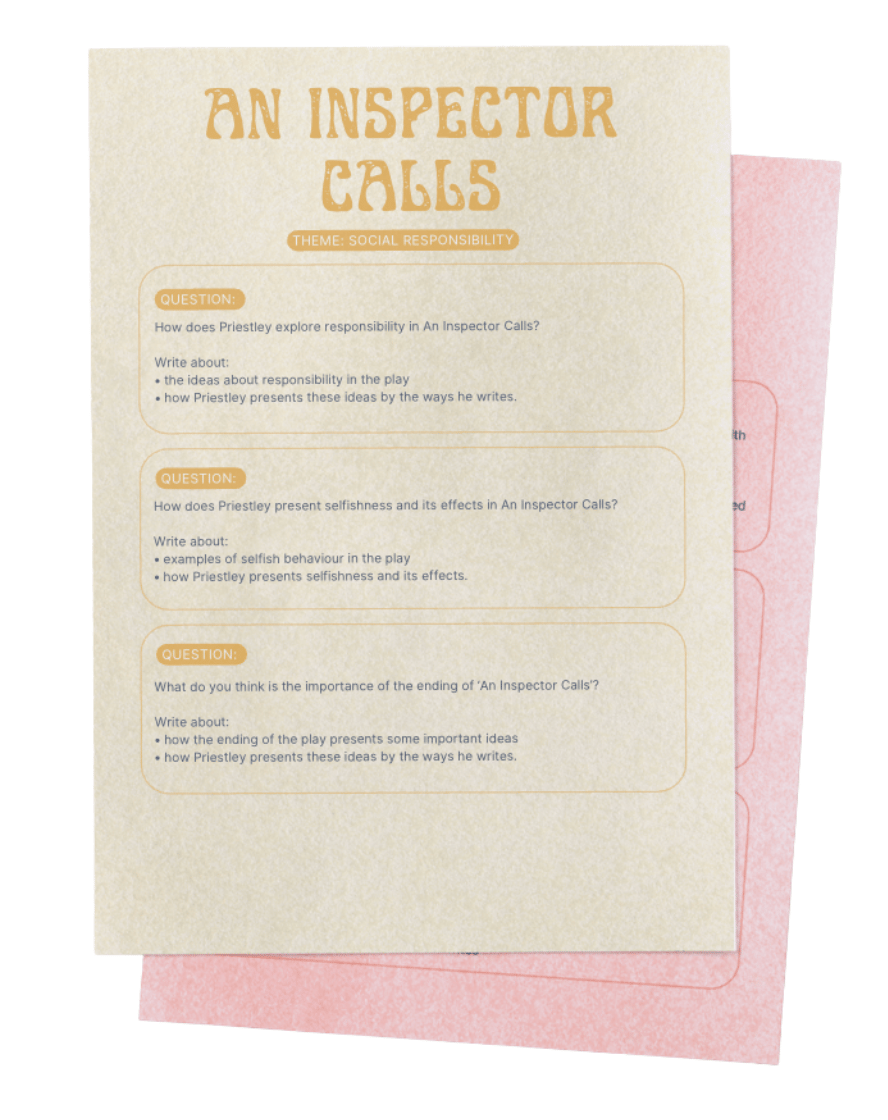
This week's freebie is a compiled list of every AQA GCSE English Literature past paper question for An Inspector Calls, organised by theme and character so you can see exactly what keeps coming up.
I've also included 6 of my own predicted exam questions to give you even more practice material. And if you'd like me to put something like this together for other texts, just drop me a message.
2. Active Recall (Test Yourself Before You Look)
Close your notes. Write down everything you remember about a topic.
Then check what you missed.
This feels harder than just reading notes. That's because it is harder.
But the struggle is what makes it stick.
3. Spaced Repetition (Revisit Topics Multiple Times)
Don't revise a topic once and never look at it again.
Revisit it:
Tomorrow
In 3 days
In a week
In two weeks
Each time, test yourself before looking at your notes.
This is called spaced repetition, and it's one of the most effective study methods ever researched.
My Forgetting Curve Revision Tracker, helps you ensure each topic is visited.
4. Fix Your Mistakes Immediately
When you get a question wrong, don't just move on.
Compare your answer to the mark scheme
Identify one specific thing you missed
Rewrite the answer immediately - this time correctly
This trains your brain to avoid the same mistake next time.
5. Use Templates and Structures
Top students don't write every answer from scratch.
They have mental templates for common question types.
For example, in English:
"[Writer] presents [character] as [adjective]. This is shown through [technique], which [effect]. This reinforces the theme of [theme]."
In Science:
"When [X] increases, [Y] increases because [explanation]. This means [conclusion]."
Learn these structures. Drill them. Then adapt them to any question.
Final Thought
Notes aren't a scam.
But using them as your main revision method is.
Because exams don't test whether you can write information down.
They test whether you can retrieve it, apply it, and structure it under pressure.
And the only way to get good at that is to practise doing it.
So yes, make notes if they help you organise information.
But spend most of your time on what actually raises your grade:
Practice questions
Active recall
Spaced repetition
Fixing mistakes
Drilling structures
That's what top students do.
And that's what actually works.
