
Time for another GCSE myth to die:
Grade 9 students are NOT revising for 5 hours a night.
They’re not superhuman.
They’re not burning themselves out.
They’re not rewriting notes until their hand cramps.
The truth?
They’re doing short, high-impact, exam-focused sessions that actually move their grade.
And the best part:
You can steal their exact routine and it only takes 30 minutes.
Why This Routine Works (Before We Start)
Most revision fails for one simple reason:
It’s passive.
Passive revision feels productive:
rereading notes
highlighting
watching videos
copying summaries
But it doesn’t test anything.
This routine works because every step is active.
You’re forced to:
retrieve from memory
compare with success criteria
fix mistakes
save what works
That’s why it raises grades.
Now - the routine.
To make this easier, I’ve put together a free PDF worksheet you can follow along with as you do this method.
It breaks the 30 minutes into clear steps so you’re never staring at a blank page.
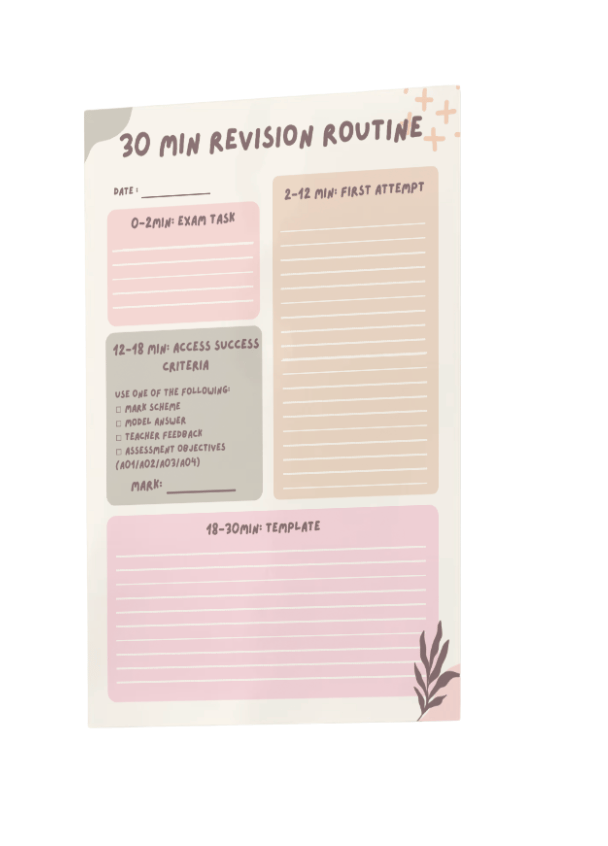
MINUTES 0–2: Pick ONE Exam Task (Not a Topic)
Don’t say:
“I’m going to revise photosynthesis.”
Say:
👉 “I’m answering this past paper question on the factors affecting photosynthesis.”
Topics are vague.
Tasks are specific.
This is the first shift from passive → active.
You’re no longer “going over content”.
You’re training for the exam.
MINUTES 2-12: First Attempt (Badly Is Fine)
This is where most students hesitate - so let’s be clear.
You are not trying to write a perfect answer.
You are trying to get something down.
What you do in these 10 minutes depends on the subject and the question length:
If it’s a longer essay-style question (English / Humanities):
Don’t write the full essay.
Write a detailed plan from memory:
your main points
the evidence or examples you’d use
how each point links to the question
If it’s a medium-length question (12–16 markers):
Write one strong paragraph in full
OR a full plan covering all points, depending on time
If it’s Science:
Answer the whole exam question if possible
Especially for:
4–6 markers
required practical questions
calculation questions
If it’s Maths:
Complete one exam-style question
Or a small set of linked questions on the same skill
Across all subjects, the rules stay the same:
no notes
no pausing
messy is allowed
This is active retrieval: the most powerful form of learning
Your first attempt isn’t the revision.
The improvement is.
MINUTES 12-18: Access the Success Criteria
This is the moment your brain actually learns.
Compare what you wrote with what the examiner rewards
Use one of the following (exactly like in the PDF):
mark scheme
model answer
teacher feedback
assessment objectives (AO1 / AO2 / AO3 / AO4)
You’re looking for gaps:
missing keywords
weak links to the question
missing method / effect
unclear structure
This is the “ohhh - that’s what they want” moment Grade 9 students get regularly.
MINUTES 18-25: Rewrite ONE Better Version
This step turns mistakes into technique.
Just fix what was missing or weak in your first attempt
That might be:
one model paragraph
a few sentences from the mark scheme
one correct calculation
This is where your technique levels up.
It’s active.
It’s uncomfortable.
And it’s exactly why the routine works.
MINUTES 25-30: Save It as a Template
This is the secret most students miss.
Save your improved answer as a reusable structure:
“English Language Q2 template”
“Biology Required Practical 3 Method 6-marker template”
“Geography Case Study 9-mark evaluate answer”
“Maths Volume of Compound Shapes full method”
Next time you revise, you’re not starting from scratch -
you’re starting from something that already works.
That’s how revision compounds instead of repeating.
What This Routine Quietly Fixes
Without realising it, this routine:
replaces passive revision with active revision
removes decision fatigue
builds exam-ready templates
makes progress visible
You’re not revising more.
You’re revising with intent.
CONCLUSION
Thanks for being here - seriously.
Each week, I’ll send you one powerful strategy to help you beat a system that rewards technique over intelligence.
You’ll get free resources, cheat sheets, and first access to the tools I’m building - from subject-specific AI prompt packs to the full GCSE Quest System that turns revision into a game you can actually win.
For context: I got almost all 9s at GCSE, I’m 23 now, and I’ve been tutoring for 3+ years. I’ve watched students go from “I can’t do this” to Grade 8s and 9s - not because they changed who they were, but because they changed their strategy.
See you next week
