
Let’s talk about something no English teacher will ever tell you:
Examiners don’t want beautiful writing. They want predictable, mark-scheme-shaped answers.
Every year, the SAME problem happens:
Brilliant, creative, thoughtful students get stuck on Grade 5/6.
Meanwhile, students who write short, robotic, structured paragraphs get 8s and 9s.
Why?
Because the mark scheme rewards a script, not a masterpiece.
Let me show you how to write like the robot they want.
What Examiners are Actually Looking For
1. Clear thinking beats fancy vocabulary
Using big words doesn’t earn marks by itself.
Examiners prefer answers that are:
short and focused
built around quotations
clear about the method being used
clear about the effect on the reader
If your paragraph is easy to follow, it’s easier to reward.
2. High-grade answers follow a pattern
Top answers don’t “flow naturally”.
They follow a repeatable structure.
Use this structure:
POINT →
The writer presents ______________.
EVIDENCE →
This is shown when they say, “__________”.
METHOD →
The writer uses __________ (method).
EFFECT →
This creates the impression that __________.
LINK →
This suggests the writer wants us to understand __________.
3. Analysis matters more than opinion
Saying “I think” doesn’t add marks.
What does add marks is:
naming the technique
explaining what it creates or suggests
linking that effect to the writer’s purpose
For example, instead of saying a line is “powerful”, you explain why it feels powerful.
4. Precision matters more than length
Writing everything you know is a trap.
Examiners don’t reward knowledge dumps.
They reward answers that directly answer the question.
One strong, controlled paragraph is worth more than three unfocused ones.
How the Method–Effect Phrase Bank helps
This week’s freebie - the Method–Effect Phrase Bank - is designed for exactly this problem.
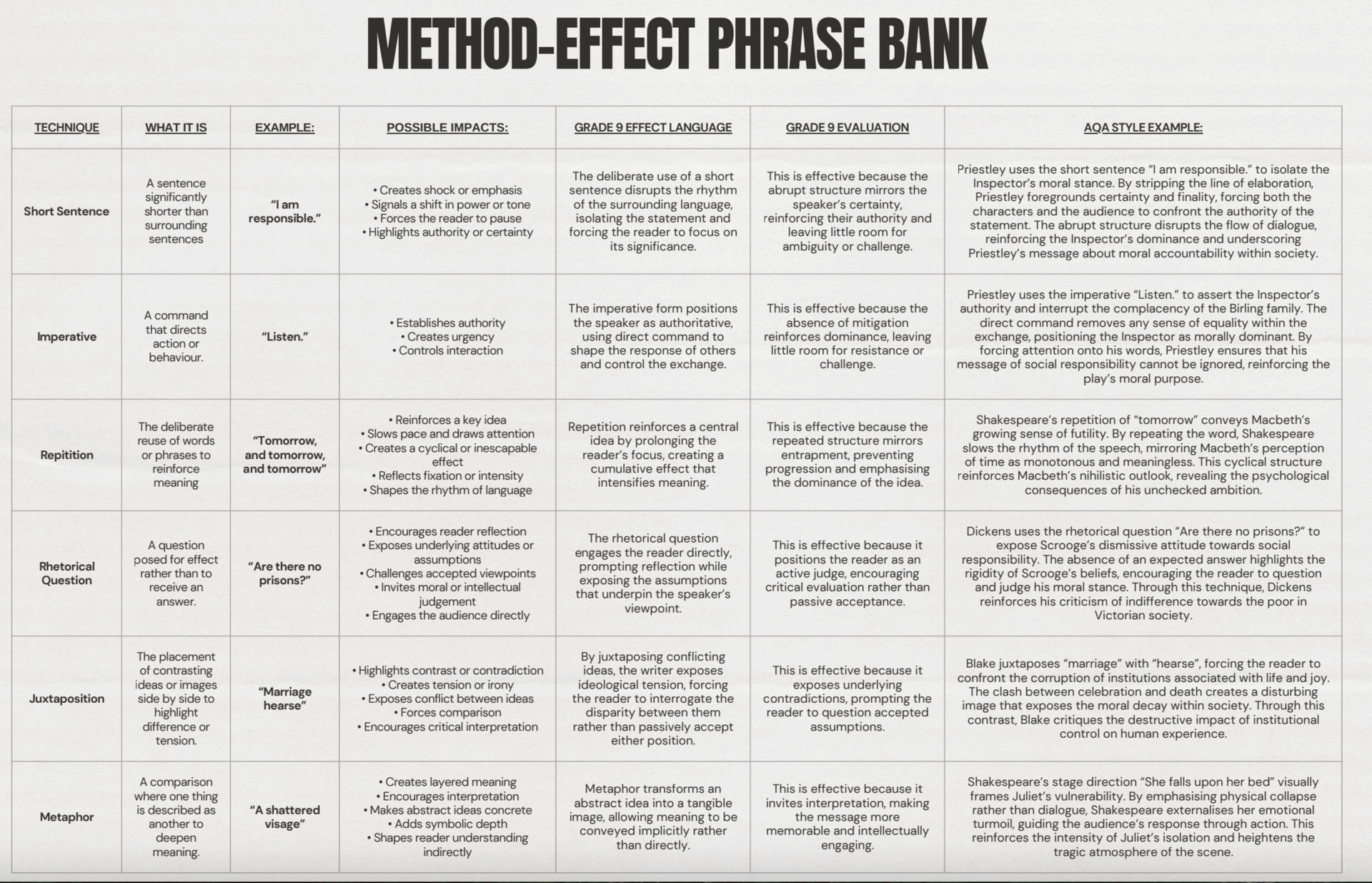
It helps you:
name techniques accurately (like short sentences, imperatives, repetition, metaphor)
describe effects in exam-ready language
avoid vague phrases like “this shows”
sound analytical without overthinking
When to use it:
while practising paragraphs at home
when improving a weak answer
before exams to sharpen your wording
You’re not meant to memorise it.
You’re meant to borrow the language so your analysis sounds clear and controlled.
If you master this, you will look like a Grade 9 student to any examiner.
Write like a robot in the exam. Write like a human in coursework.
GCSEs want structure.
They want repeatable patterns.
They want formula answers.
Learn the formula → get the grade.
