
Let’s talk about avoidance.
You know the revision method that:
feels uncomfortable
makes you nervous
exposes what you don’t know
forces you to face mistakes
feels “too real”
Yes - exam questions.
And yes - that is exactly the method that raises your grade the fastest.
Your brain avoids them because they feel hard.
Your emotions avoid them because they reveal weaknesses.
But weaknesses are where improvement actually happens.
Most students think they’re choosing how to revise.
What they’re actually choosing is this:
comfort or progress
passive or active
feeling ready or getting ready
Passive revision feels safer:
rereading notes
highlighting
watching videos
copying summaries
Active revision feels risky:
answering questions
writing from memory
checking against the mark scheme
fixing mistakes
One feels productive.
The other produces results.
And when stress hits, most students drift toward the safer option - without realising it.
1️⃣ “I’m Not Ready Yet” Is the Biggest Lie Revision Tells You
Students avoid exam questions because they think:
“I need to revise more first.”
“I don’t know the topic well enough.”
“What if I do badly?”
“I’ll do questions later.”
Here’s the truth:
👉 You don’t become ready then do questions.
👉 You do questions to become ready.
Waiting to feel confident is how revision quietly turns into avoidance.
2️⃣ Why Passive Revision Feels Good - But Fails You
Passive methods aren’t useless.
They help you understand.
The problem is when revision stops there.
Passive revision creates thoughts like:
“I recognise this.”
“It makes sense when I read it.”
“I’ll remember it in the exam.”
Your brain mistakes familiarity for mastery.
That’s why students revise for hours…
then freeze when the paper is in front of them.
Nothing has been retrieved.
Nothing has been tested.
Nothing has been proven.
3️⃣ Active Revision Feels Uncomfortable Because It’s Honest
Active revision doesn’t let you hide.
Exam questions show you:
what you actually know
what you don’t
how marks are awarded
what structure the examiner expects
That honesty is uncomfortable - but powerful.
This is why I use tools like the Active vs Passive Revision Checklist with students.
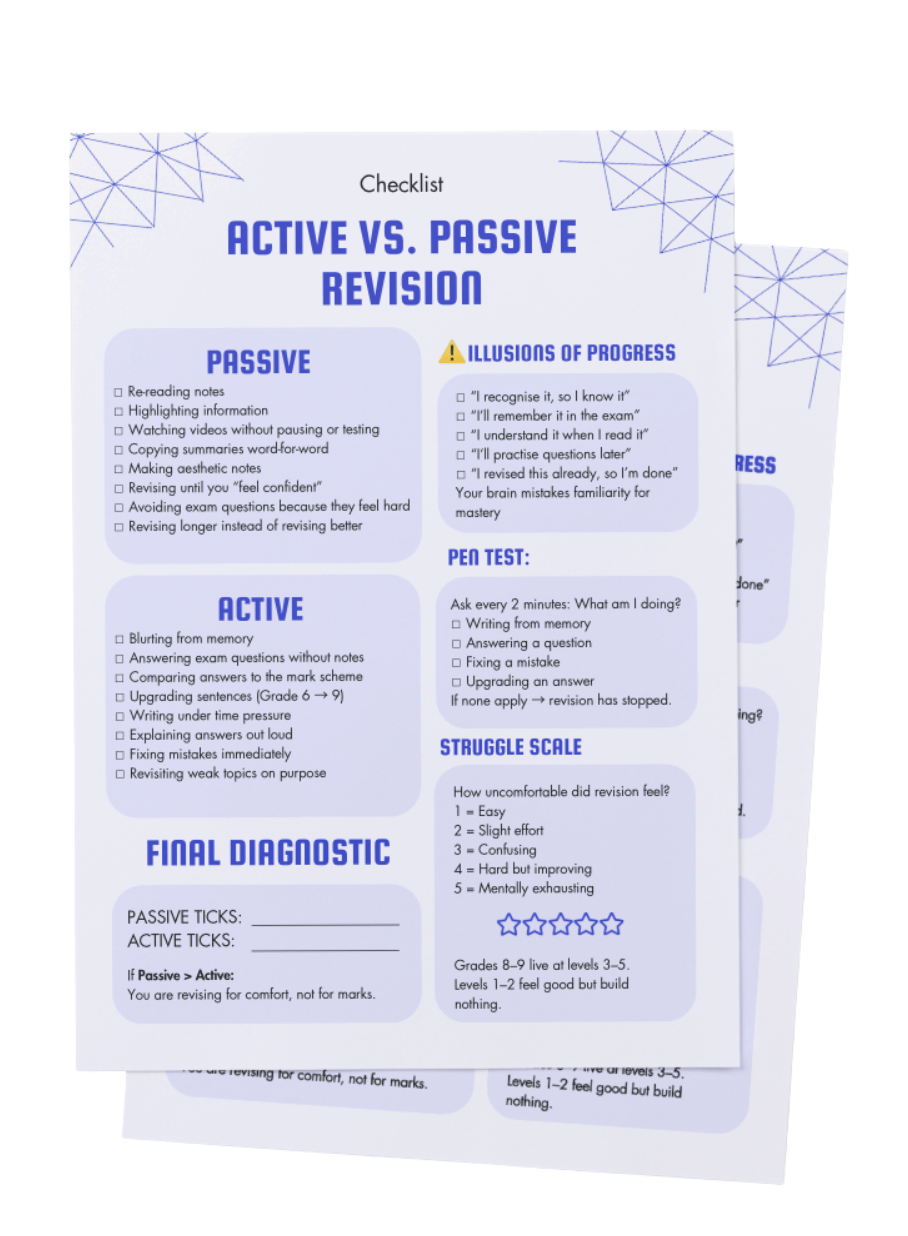
If most of what you’re doing is passive, it explains everything.
4️⃣ The Shift That Changes Everything
You don’t need to stop passive revision completely.
You just need to stop ending there.
The rule is simple:
If revision doesn’t end with output, it won’t stick.
Read → then answer
Watch → then explain
Learn → then test
That’s how passive becomes active.
That’s how avoidance turns into progress.
5️⃣ Start Before You Feel Ready
You don’t need to:
finish the topic
revise everything first
feel confident
“get your life together”
You do this instead:
pick one exam question
answer it badly
feel confused
feel exposed
improve it anyway
That single action breaks the avoidance cycle.
Once you’ve done one question, revision stops feeling scary -
because you’re no longer imagining failure.
You’re working with reality.
Bottom Line
The revision method you’re avoiding is probably the one you need most.
If it feels uncomfortable, exposing, or “too real” -
you’re likely doing something that actually moves your grade.
Face it once.
Fix it once.
And revision stops feeling scary - because it finally starts working.
CONCLUSION
Thanks for being here - seriously.
Each week, I’ll send you one powerful strategy to help you beat a system that rewards technique over intelligence.
You’ll get free resources, cheat sheets, and first access to the tools I’m building - from subject-specific AI prompt packs to the full GCSE Quest System, designed to make revision feel manageable, structured, and actually effective.
For context: I got almost all 9s at GCSE, I’m 23 now, and I’ve been tutoring for 3+ years. I’ve helped countless overwhelmed students go from freezing to progressing - not by pushing harder, but by simplifying the process.
I want that for you too.
See you next week - more tactics coming.
