
Let me start with something most teachers won't say out loud:
You can memorise every quote, know every theme, and still write essays that sound flat.
I've tutored students who could recite whole scenes from Macbeth. They understood the context. They knew the techniques.
But their essays read like a shopping list of points held together with "also" and "another example is."
If that sounds familiar, here's why it happens - and what you can actually do about it.
The Real Problem: You're Describing, Not Analysing
Most students write something like this:
"Shakespeare uses the metaphor 'life's but a walking shadow' to show Macbeth feels his life is meaningless."
That's description. You've spotted the technique and said what it means.
But you haven't analysed it.
Analysis is about digging into why the writer chose that specific word or image, and what effect it creates.
Here's the same point, analysed properly:
"Shakespeare's metaphor 'life's but a walking shadow' makes life sound temporary and unreal - like it has no weight or substance. The word 'shadow' suggests something dark and empty, while 'walking' makes it feel aimless, like Macbeth is just going through the motions with no purpose. This shows how completely hopeless and broken he's become."
See the difference?
You're not just naming what Shakespeare did. You're explaining his intent and the effect on the reader.
That's what moves you from a 6 to an 8 or 9.
Why "Sounding Basic" Actually Matters
Let me be clear: basic doesn't mean simple.
Simple writing is good. Clear writing is good.
Basic writing is when your essay sounds like bullet points stuck together.
Here's the problem:
Even if your points are solid, if you can't express them fluently, examiners notice. Your essay feels clunky. It doesn't flow.
And more importantly - essay writing is a separate skill.
You can learn every fact for History. Memorise every language technique for English. Know every case study for Geography.
But if you can't structure an argument, link your ideas, or write with variety - you won't hit the top grades.
Because GCSEs don't just test knowledge. They test how well you communicate that knowledge under pressure.
What Actually Improves Your Writing
Here's what worked for me (and what I've seen work for dozens of students I've tutored):
1. Stop Just Memorising Quotes - Memorise the Analysis Too
This is huge.
Most students memorise "Fair is foul, and foul is fair" and think they're done.
Smart students memorise:
It's an oxymoron
It shows moral inversion - good and evil are reversed
Links to appearance vs reality
Introduces the witches' corrupting influence
Can be used for themes of deception, ambition, or guilt
Now that quote is flexible. You can adapt it to different essay questions because you understand how it works, not just what it says.
This is what separates students who panic in exams from students who can think on their feet.
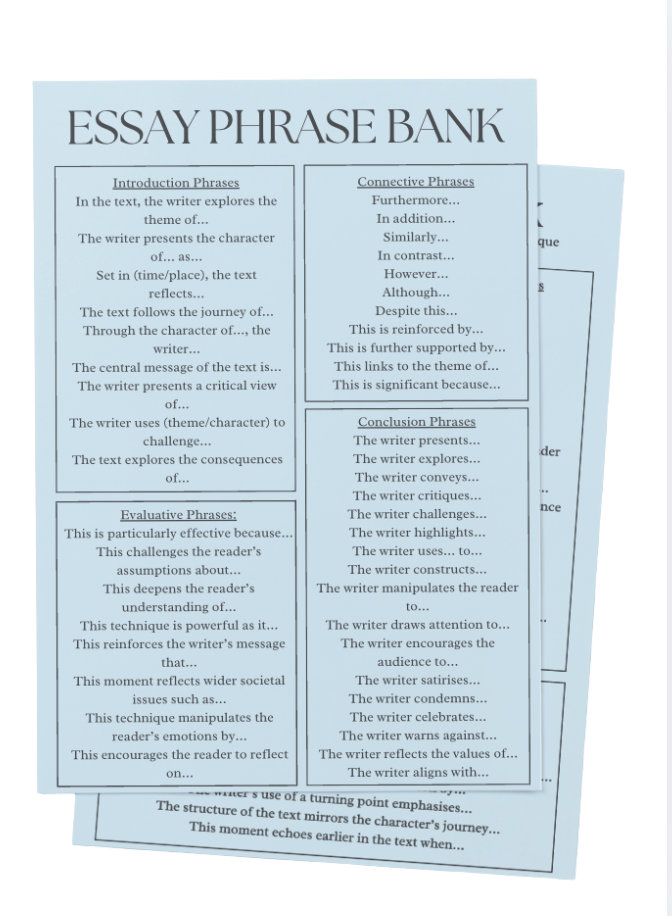
2. Build a Phrase Bank (And Actually Use It)
This sounds simple, but it's one of the most effective things you can do.
Keep a list of high-quality sentence starters and analytical phrases that you can plug your own ideas into.
For example, instead of repeating "This shows that..." over and over, you could use:
"This suggests…"
"This reveals…"
"This implies…"
"This reinforces the idea that…"
Or instead of always writing "Shakespeare shows…" try:
"Shakespeare presents…"
"Shakespeare critiques…"
"Shakespeare manipulates the reader into…"
Memorise 10–15 of these. Practise using them in timed paragraphs.
Over time, they'll become automatic - and your essays will sound more sophisticated without you even thinking about it.
I've put together a full Phrase Bank you can grab for free with this email - it's got everything from analysis starters to introduction phrases to conclusion structures. Print it, stick it above your desk, and use it every time you practise writing.
3. Make Your Essays Flow
Flow isn't magic. It's just linking your ideas so one paragraph leads naturally into the next.
Here's how:
Don't start every paragraph the same way.
Avoid:
"Another example is…"
"Also, Shakespeare shows…"
"In addition…"
Instead, connect your ideas:
"This sense of guilt is developed further when…"
"Shakespeare intensifies this imagery by…"
"In contrast to this earlier optimism…"
Use connectives that show the relationship between paragraphs:
To build on an idea: "Furthermore," "Moreover," "Building on this"
To contrast: "However," "Conversely," "In contrast"
To conclude: "Ultimately," "This suggests," "Taken together"
Your essay should feel like one continuous argument, not five mini-essays stuck together.
4. Master Essay Planning (Not Just Writing)
Here's a quick test:
Can you look at an unseen exam question and immediately think of:
3 solid points you could make
3 pieces of evidence to back them up
If yes - you're halfway there.
If not - you need to practise planning more than writing.
I used to spend 5 minutes before every practice essay just thinking:
What's the question actually asking?
What's my overall argument?
What 3 points prove that argument?
What evidence supports each point?
Once you can do that instinctively, the actual writing becomes so much easier.
Because you're not figuring out what to say while also trying to figure out how to say it.
5. Only Write Full Intros and Conclusions When You Practise
Here's something that helped me massively during GCSEs:
Don't write full essays every single time you revise.
Instead:
Write full introductions and conclusions (because these vary with every question and show your sophistication)
For middle paragraphs, just practise the structure - Point, Evidence, Explanation, Context
Why?
Because middle paragraphs follow the same format every time. You don't need to write them out in full every session.
But intros and conclusions are unique to each question. They're where you prove to the examiner you understand what's being asked and can respond with control.
Practise those. A lot.
You'll get faster, sharper, and more confident at framing arguments under pressure.
6. Expand Your Vocabulary the Right Way
Your vocabulary doesn't come from memorising random word lists.
It comes from absorbing language everywhere:
The people you speak to
The books you read
The shows you watch
The podcasts you listen to
The more you're exposed to sophisticated phrasing, the more it naturally seeps into your writing.
Here's how to be intentional about it:
When you read something well-written, note down phrases that sound good
When you hear a word you don't normally use, look it up and try using it in your own sentences
Research shows you need to use a word around 17 times before it sticks - so deliberately use new words until they feel natural
Also: learn synonyms for overused phrases.
Instead of "This shows…" every single time, mix it up:
"This suggests…"
"This implies…"
"This conveys…"
"This reveals…"
"This highlights…"
Small changes like this add up fast.
(All of these are in the free Phrase Bank I mentioned earlier — grab it and start using them in practice essays this week.)
7. Add Purpose, Intention, and Effect to Every Point
This is the shift that takes you from a Grade 6 to a Grade 8 or 9.
Instead of just saying what a technique does, explain:
Why the writer chose it (purpose/intention)
What effect it has on the reader (impact)
For example:
Basic (Grade 5–6):
"Dickens uses the simile 'solitary as an oyster' to show Scrooge is lonely."
Analytical (Grade 8–9):
"Dickens' simile 'solitary as an oyster' presents Scrooge as emotionally sealed off from society. The imagery of a shell suggests self-imposed isolation - just as an oyster retreats into its hard exterior, Scrooge withdraws from human connection. This reinforces Dickens' critique of individualism and greed in Victorian England."
You're not just identifying the technique. You're unpacking why it matters and what Dickens is trying to make the reader feel or think.
That's analysis.
